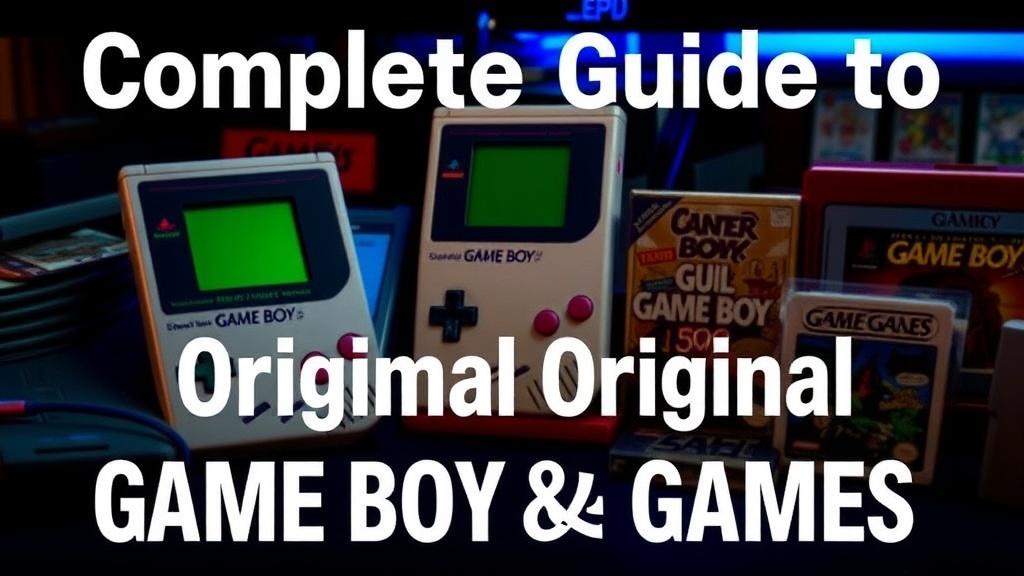
Complete Guide to Collecting Original Game Boy Consoles and Games

This guide covers everything needed to start or refine a collection of Nintendo's original Game Boy hardware and software—from identifying authentic units and valuing cartridges to understanding regional variants and long-term storage. Whether building a nostalgia-driven display or hunting for investment-grade rarities, knowing the market's nuances saves money and prevents costly mistakes.
Which Original Game Boy Model Should You Actually Buy?
The original DMG-01 (released 1989) remains the most collectible variant, but it's not always the best choice for actual gameplay. Nintendo produced several hardware revisions during the original Game Boy's lifespan—each with distinct trade-offs that serious collectors should understand.
The "brick" style DMG-01 features that iconic gray casing and green-tinted screen. Early units display sharp pixels but suffer from notorious screen ghosting. Later production runs (roughly 1994 onward) used revised LCD controllers that reduced motion blur significantly. Worth noting: many sellers don't distinguish between early and late production DMG units—so ask about serial numbers or motherboard revisions before paying premium prices.
The Game Boy Pocket (1996) shrank the form factor and introduced a true black-and-white screen. It's gorgeous. The backlight-less display actually looks sharper than the original DMG in good lighting—no green tint washing everything out. The catch? Battery life dropped from 30+ hours to roughly 10 hours on two AAA batteries. Some collectors hunt specific Pocket variants—the Japan-exclusive clear atomic purple model commands serious premiums.
The Game Boy Light (1998) never released outside Japan. It's basically a Pocket with an electroluminescent backlight—Nintendo's first backlit handheld. Prices on eBay typically run $150-$300 depending on condition. The backlight creates an iconic blue glow that photographs beautifully (and actually lets you play in bed).
Here's the thing: condition matters exponentially more than model when valuing original Game Boy hardware. A mint DMG-01 in box outperforms a beat-up Game Boy Light every time. Focus on screen quality first—dead pixels, vertical lines, and contrast fade can't really be fixed. Scratched cases can be swapped. Broken screens usually can't.
| Model | Release Year | Key Feature | Typical Price Range (Loose) |
|---|---|---|---|
| DMG-01 (Original) | 1989 | Iconic design, 30hr battery | $40 - $120 |
| Game Boy Pocket | 1996 | True B&W screen, compact | $50 - $150 |
| Game Boy Light | 1998 | Backlight (Japan only) | $150 - $300 |
| Game Boy Color | 1998 | Color screen, backwards compatible | $50 - $200 |
How Do You Spot Fake or Reproduction Game Boy Cartridges?
Counterfeit Game Boy cartridges flooded the market around 2015 when reproduction PCBs became cheap and accessible. Learning authentication basics protects your investment—especially when hunting expensive titles like Shantae, Spud's Adventure, or Amazing Tater.
Authentic cartridges use specific board designs Nintendo manufactured. Open any cart (tri-wing screwdriver required) and look for Nintendo branding on the PCB itself—reproductions rarely replicate this correctly. The chip arrangement matters too: genuine carts typically show one or two ROM chips plus a battery for save functionality. Repros often use a single flash chip crammed with everything.
Labels tell stories if you know where to look. Nintendo used specific paper stocks and printing methods across different production eras. Early games (1989-1992) feature matte labels with slightly raised ink you can feel under your thumb. Mid-period releases switched to glossier finishes. Reproduction labels often look "too perfect"—colors too saturated, text too sharp, or that giveaway pixelated scaling from low-resolution source images.
Batteries are another giveaway. Authentic save batteries show Nintendo branding or specific part numbers (CR2025 or CR1616 typically). Reproductions use generic unbranded cells. That said, replacement batteries in otherwise authentic carts aren't automatically suspicious—batteries die after 15-20 years and many collectors replace them proactively.
Weight provides a quick heuristic. Genuine carts feel substantial—Nintendo used quality plastic and proper shielding. Reproductions often feel hollow or lighter. It's not definitive (some late-period Nintendo carts were lighter too), but combined with other factors, it helps.
Buying from established sellers helps, obviously. PriceCharting tracks market values and seller reputations. Vancouver-based collectors have additional options—local shops like Video Games Plus authenticate inventory before sale. That said, the hunt at flea markets and estate sales remains part of the fun—just bring a tri-wing screwdriver and know what to check.
What Are the Most Valuable Original Game Boy Games in 2024?
Rarity and value don't always correlate in Game Boy collecting. Some genuinely rare games stay affordable because nobody wants them. Conversely, common games in sealed condition can outprice scarce loose carts. Understanding what actually drives prices helps build a collection worth keeping—or eventually selling.
Shantae (2002) sits atop most value lists for good reason. WayForward released it extremely late in the Game Boy Color's lifespan—most retailers had already cleared shelf space for Game Boy Advance software. Print runs were tiny. Complete-in-box copies now trade for $800-$1,500 depending on condition. Loose carts still fetch $300-$500. The game earned its reputation honestly—it's genuinely excellent, arguably the best original Game Boy platformer.
Spud's Adventure and Amazing Tater (both Atlus puzzle games from 1991) represent the "sleeper hit" category. Neither reviewed spectacularly at release. Atlus printed conservatively. Three decades later, both command $150-$300 for loose cartridges simply because supply evaporated while a dedicated cult following emerged. Worth noting: these games aren't actually that fun for most modern players. Collect them for rarity, not gameplay.
The Pokemon series deserves special mention. Original Red and Blue aren't rare—Nintendo printed millions. But sealed, graded copies in pristine condition trade for absurd money ($1,000+) because Pokemon maintains massive mainstream appeal. Meanwhile, genuinely scarce games like Dexterity or Quarth languish at $30-50 because nobody's heard of them.
Regional exclusives create interesting arbitrage opportunities. For the Frog the Bell Tolls (Japan only) never released outside Nintendo's home market—yet it directly inspired Link's Awakening's engine and shares staff with the Zelda team. Japanese copies run ¥3,000-¥8,000 (roughly $20-$55 USD) despite being completely unavailable officially in North America. Fan translations exist, making these playable for English collectors willing to import.
Storage and Preservation Best Practices
Original Game Boy hardware ages surprisingly well compared to disc-based systems—no optical drives to fail, no capacitors leaking onto motherboards (usually). But proper storage prevents the degradation that does occur.
Remove batteries from both consoles and cartridges before long-term storage. Alkaline leakage destroys contacts and PCB traces. For consoles using AA or AAA batteries, this means popping them out entirely. For save batteries in cartridges—well, those need periodic replacement anyway. Expect 15-20 year lifespans under normal conditions.
UV light yellows the ABS plastic Nintendo used for Game Boy casings. Display collections away from direct sunlight. For DMG-01 units already showing yellowing, retr0bright treatments can reverse oxidation—but it's a finicky process involving hydrogen peroxide and UV exposure that risks damaging labels and rubber membranes. Most collectors accept some patina as character.
Screen protection matters. The original DMG's plastic lens scratches easily—replacement glass lenses cost $5-10 and install with simple double-sided adhesive. For preservation-grade collections, keeping original lenses (scratches and all) maintains authenticity even if playing copies use replacements.
Cartridge shells crack at the screw posts—that's the most common physical damage. Temperature cycling (hot attic to cold basement) accelerates this. Store games in climate-controlled spaces, ideally in their original cases or protective plastic sleeves. The loose carts-in-a-shoebox approach works short-term but risks label wear and connector damage.
Where to Hunt for Original Game Boy Collectibles
The market fragmented significantly post-2020. Understanding where different types of inventory appear helps target specific collecting goals.
eBay remains the default for graded, high-value sales. Professional grading services (WATA, VGA) slabbed countless sealed games during the 2020-2022 speculation bubble. Those units mostly trade through eBay auctions now, often at prices detached from actual gameplay value. For serious investment collecting, this is the arena—but expect to pay premiums.
Facebook Marketplace and Craigslist reward persistent local hunters. Estate sales from aging original owners still surface untouched collections. The Vancouver area specifically sees regular estate liquidations from tech-industry retirees who bought Nintendo hardware for kids in the early 90s. These collections often include boxes and manuals sellers don't recognize as valuable—opportunity for educated buyers.
Specialized forums and Discord servers cater to serious collectors. Communities like r/Gameboy maintain "for sale" threads with reputation systems that reduce scam risk compared to anonymous marketplaces. Members often trade rather than sell—excess doubles for missing wants. Building relationships in these spaces takes time but yields better prices than public markets.
Japanese auction sites (Yahoo Auctions Japan via proxy services like Buyee or ZenMarket) access inventory never exported originally. Boxed Famicom-to-Game Boy adapter sets, limited edition Pokémon consoles, and regional exclusives appear regularly at prices 30-50% below North American equivalents. Shipping adds cost and complication, but the selection justifies the hassle for serious collectors.
That said, condition standards vary culturally. Japanese sellers often rate "good condition" items North American collectors would consider damaged. Read descriptions carefully, examine all provided photos, and factor proxy fees (typically 10-15% plus international shipping) into your calculations.
The hunt itself becomes addictive. There's something specific about holding thirty-year-old hardware that survived countless backpack trips, school bus rides, and late-night battery swaps. Each scratch tells a story—these weren't museum pieces, they were tools for childhood entertainment. Collecting Game Boy hardware means preserving that history while (hopefully) making smart acquisitions that hold value. Start with what you actually want to play. The investment upside, if it comes, is just a bonus.