Regional Differences in Game Boy Packaging: Collecting Japanese vs. North American Releases

You’ll learn how to identify the physical and aesthetic differences between Japanese and North American Game Boy packaging, helping you decide which region fits your shelf space and budget. Collecting across borders isn’t just about the games—it's about the cardboard, the art, and the history tucked inside those small boxes.
For many years, collectors in North America focused solely on the games they grew up with. They looked for the familiar square boxes with the silver or gold Nintendo Seal of Quality. But lately, the market has shifted. More people are looking toward Japan, not just because the games are often cheaper, but because the packaging is entirely different. If you’ve ever held a Japanese Game Boy box next to a North American one, you know exactly what I’m talking about. The sizes don't match, the art is often superior, and even the cardboard feels different in your hands.
How do Japanese Game Boy box sizes differ from North American versions?
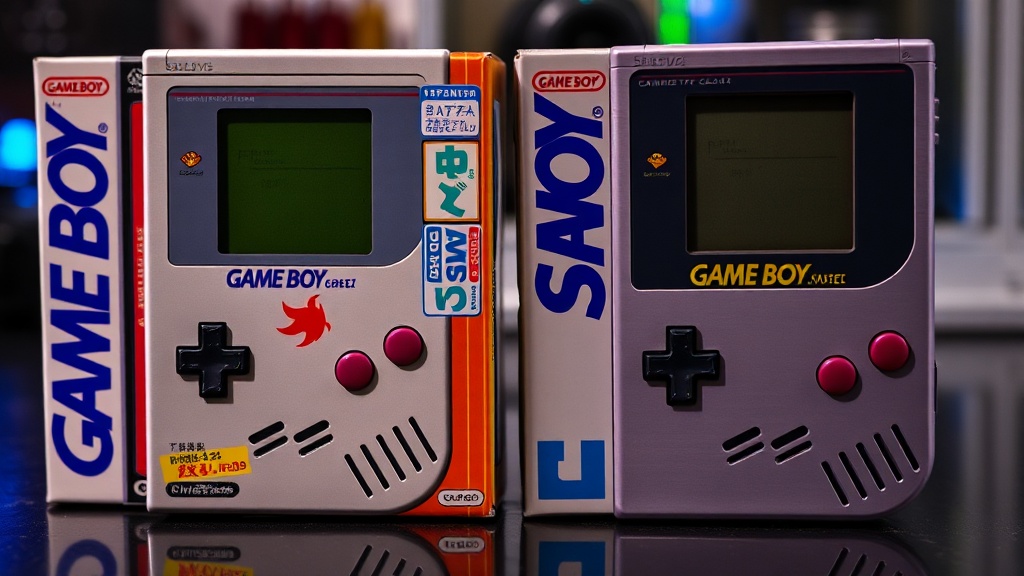
The most immediate difference is the physical dimension. North American Game Boy boxes are roughly 12.5cm by 12.5cm, creating a nearly square appearance. They’re designed to be displayed with the spine facing out, or stacked horizontally. In contrast, Japanese Game Boy boxes are much smaller and follow a vertical, portrait-style layout. These Japanese boxes usually measure about 10cm wide and 12.5cm tall (though some early releases vary slightly). This makes them feel much more compact and, frankly, more appropriate for a handheld console that was marketed on its portability.
Because the Japanese boxes are thinner and narrower, you can fit significantly more of them on a standard media shelf than you can with North American releases. This is a big deal if you’re running out of space in your game room. A shelf that holds thirty North American titles might hold forty or fifty Japanese ones. The Japanese versions also tend to use a lighter weight of cardstock. While this makes them feel a bit more delicate, they often have a glossy finish that has held up remarkably well over the last thirty years. The North American boxes, meanwhile, used a thicker, matte-finish cardboard that is notorious for showing "shelf wear"—those white scuffs along the edges that drive collectors crazy.
Inside the boxes, the structural differences continue. North American releases almost always used a cardboard tray (the "inner") that was part of the box fold or a separate insert to hold the cartridge in place. Japanese releases frequently used a clear plastic tray. This plastic tray (or "shink") protected the cartridge and the manual much better than the cardboard flaps found in Western releases. When you're buying "Complete in Box" (CIB) games today, finding that original plastic tray in a Japanese copy is a sign that the previous owner took good care of their collection.
What are the most noticeable differences in Game Boy box art design?
Design philosophy in the late 80s and early 90s varied wildly between Nintendo of America and Nintendo Co., Ltd. in Japan. In North America, the "Game Boy" logo was a massive, dominant feature. It lived in a grey or silver vertical stripe on the left side of the box, taking up nearly a quarter of the front-facing real estate. This branding was strong, but it forced the actual game art into a smaller window. It made every game look like part of a unified set, which was great for brand recognition but sometimes boring for the art itself.
Japanese boxes didn't have this restriction. The "Game Boy" logo was often smaller and tucked into a corner, allowing the cover illustration to breathe. Take a look at the original Kirby’s Dream Land (Hoshi no Kirby). The Japanese box features a beautiful, colorful illustration that fills the entire front cover. The North American version is great, but it’s cramped. More famously, the Japanese version of Tetris features a whimsical, colorful illustration of the blocks and a Kremlin-inspired tower, whereas the North American version is much more clinical and graphic-heavy. You can see many of these art variations detailed on Console Variations, which tracks these regional shifts across thousands of entries.
Then there’s the matter of the Seal of Quality. In North America, that gold or silver oval is a permanent fixture. In Japan, it doesn't exist. Instead, you get the red Nintendo logo and often a small, circular "DMG" code that identifies the game’s serial number. Many collectors (myself included) find the Japanese covers to be more "pure" because they aren't cluttered with marketing seals and ESRB rating icons. Remember, the ESRB didn't start until 1994, so earlier North American Game Boy games are cleaner than later ones, but they still don't match the minimalist aesthetic often found in the East.
Color palettes also differ. Japanese designers weren't afraid of neon pinks, bright yellows, and deep purples. North American boxes tended to lean into "extreme" 90s marketing—lots of high-contrast shadows, aggressive fonts, and darker tones. This was the era of Sega vs. Nintendo, and the marketing reflected that "tude." The Japanese market remained more focused on the "toy" aspect of the console, resulting in friendlier, more inviting box art that looks stunning when lined up on a display shelf.
Which region offers the best value for serious Game Boy collectors?
If you're looking for the most bang for your buck, Japan is usually the winner—with a few big caveats. Because the Game Boy was so successful in Japan, many common titles like Super Mario Land, Dr. Mario, and Yoshi were printed in the millions. You can often find a CIB copy of Super Mario Land from a Japanese seller for $40 to $60, while a North American CIB copy might run you $150 or more. The price disparity is huge. You can check current market trends on PriceCharting to see how these gaps have widened lately.
The trade-off is the language barrier. For platformers and puzzle games, the language doesn't matter much. You don't need to read Japanese to play Tetris or Gradius. But for RPGs like The Legend of Zelda: Link’s Awakening or the Final Fantasy Legend series (known as SaGa in Japan), the Japanese version is almost unplayable if you don't know the language. This makes the Japanese versions of these games very cheap, but they’re mostly just for show unless you’re fluent. This creates a weird dynamic where a "grail" game in North America might be a "common" find in a Tokyo junk bin.
Shipping is another factor to keep in mind. Buying a single $30 game from Japan might cost you $25 in shipping, which ruins the value. Smart collectors use proxy services or buy in bulk to spread that shipping cost across ten or twenty games. When you do this, the per-game cost drops significantly, making the Japanese route much more affordable than buying domestic. Also, Japanese collectors generally take better care of their items. It is much more common to find a "Near Mint" box from Japan than from a North American seller. In the West, we tended to rip the boxes open and throw them in the trash. In Japan, keeping the box and manual was part of the ownership experience.
One final thing to consider is the "Not For Sale" and prize variants. Japan had a huge culture of magazine contests and store-exclusive promos. These versions are the holy grails of the hobby. For example, the "V-Jump" version of certain games or the special "Event" versions of Pokémon are legendary. These will cost you thousands of dollars, regardless of the region. If you want to see the official list of what was released in Japan, Nintendo’s own archive is a great place to start, even if you have to use a browser translator to read it.
Ultimately, your choice depends on what you value most. If you want the nostalgia of the games you played as a kid in Vancouver or New York, you’ll probably stick to the North American boxes. They look great and they tell a specific story about Western gaming culture. But if you want a more compact, artistic, and often more affordable collection, the Japanese market is waiting for you. Just be prepared to buy some extra protective sleeves—the Japanese cardboard is thin, and you’ll want to keep those vibrant colors from fading over the next thirty years.
Quick Tips for Identifying Region
- Box Orientation: Wide/Square = North American. Tall/Thin = Japanese.
- Serial Codes: Look for "USA" or "CAN" in the code for Western releases. Japanese codes usually end in "JPN".
- Seal of Quality: No gold/silver oval? It's likely an import (or a very convincing bootleg).
- Language: If the back of the box is 90% Kanji/Kana, you’re looking at a Japanese release.
The manual is the last place to check. Japanese manuals are often full-color and include small comics (manga) featuring the characters. North American manuals are almost always black and white after the first few pages and much more utilitarian. It’s those little extras that make the pursuit of Japanese Game Boy collectibles so rewarding for people who care about the "stuff" as much as the "game".